Homeschool Curriculum for ADHD: 6 Things to Look For
· By Kindred Team · 6 min read · Learning Differences
Choosing homeschool curriculum for ADHD? Learn what ADHD changes about learning at home and six things to look for before you buy math or reading programs.
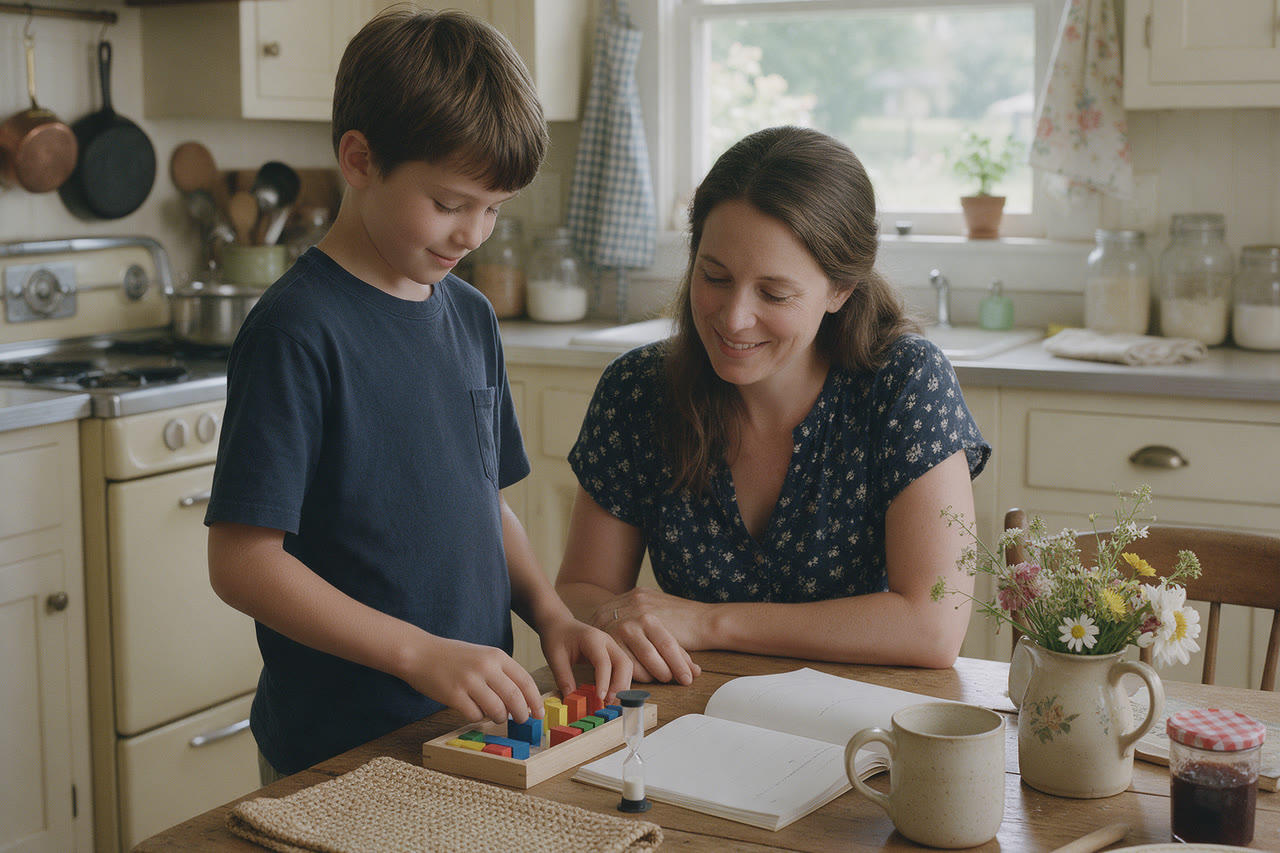
If you have ever watched your third grader melt down over a worksheet he understood perfectly yesterday, you already know something most curriculum catalogs will not tell you.
Your child is not the problem. The fit is.
An ADHD brain is not a broken version of a typical brain. It runs on different fuel, and a lot of homeschool curriculum was written with a different engine in mind. When the material asks for forty quiet minutes and a page dense with problems, a bright, capable kid can look like he is failing when he is really just mismatched.
This guide covers what ADHD actually changes about learning at home, then six concrete things to look for when you shop, with math and reading front of mind. No rankings. Just patterns, so you can recognize a good fit when you see it.
What ADHD changes about learning at home
You do not need a neuroscience degree for this. Four things matter most at the kitchen table.
Working memory is smaller. Working memory is the mental sticky note that holds a few pieces of information while you use them. CHADD, the national ADHD organization, puts it plainly: "The longer the task and the more steps necessary for its successful completion, the less likely a student with poor working memory will be able to complete it successfully." That is why a multi-step long division problem or a three-part instruction falls apart halfway through. He did not stop trying. The sticky note ran out of room.
Sustained attention comes in shorter stretches. Focus is not missing; it is spent faster. A lesson that assumes thirty uninterrupted minutes is asking for a resource your child has less of. Understood.org's guidance on brain breaks suggests a short reset after ten to twenty-five minutes of intensive work, before fatigue sets in.
Movement helps, it does not distract. Research summarized by CHADD found that children with ADHD were more accurate on attention tasks when they were moving more intensely, and their peers without ADHD showed no such benefit. A 2023 meta-analysis of ten randomized trials found physical activity produced a moderate improvement in attention problems for school-age children with ADHD. The wiggling is not defiance. It is often how he holds focus.
Interest is the on-switch. Many families describe an "interest-based" nervous system: when something is novel, hands-on, or personally meaningful, the same child who cannot sit through a phonics drill will build an elaborate Lego city for two hours. Curriculum that gives choice, quick feedback, and a reason to care tends to get further than curriculum that relies on "because it's Tuesday."
One more thing worth knowing: the CDC's most recent national parent survey estimates roughly 11.7 percent of U.S. children aged 3 to 17 currently have ADHD. That is a lot of kitchen tables. You are not alone.
Six things to look for in homeschool curriculum for ADHD
1. Short lessons with a clear finish line
Look for programs where a lesson is ten to twenty minutes and your child can see the end coming. "Do the front of this page" beats "work for a while." A visible stopping point protects working memory and gives him a win every day. Short-lesson mastery math programs, where each lesson introduces one idea and then practices it, are built on this pattern. Math-U-See, for example, pairs a short video lesson with practice pages and expects you to stay on a lesson until it is mastered, however long that takes.
2. Built-in movement or hands-on pieces
Manipulatives, letter tiles, whiteboards, and anything the hands can hold turn abstract ideas into something a body can remember. In reading, multisensory phonics programs use tiles and physical spelling to make sound-to-letter connections stick. All About Reading uses letter tiles and short, scripted lessons in this way. In math, block-based systems let a child build a number before writing it. If a program has no hands-on component, you can add one, but it is easier when it is already there.
3. Mastery-based with obvious stopping points
Mastery programs stay on one skill until it is solid, then move on. For a child whose working memory is already taxed, this means fewer skills competing for attention at once. It also lets you slow down without feeling behind, because the program expects you to.
4. Low visual clutter
Open the sample pages before you buy. A page with twelve problems, three cartoon characters, two sidebars, and a fun fact is asking an ADHD brain to filter out a lot before it can start. Clean layout, one task per section, and white space are not aesthetic preferences. They are accommodations.
5. Understand the spiral-vs-mastery trade-off
Spiral programs revisit many skills a little at a time, which builds long-term retention and keeps things varied. Mastery programs go deep on one thing, which reduces mental load but can let older skills fade without deliberate review. Neither is wrong. Some families run a mastery core and add a five-minute spiral review. Teaching Textbooks, a self-paced, computer-based math program with automatic grading, is often described as more spiral in structure; Math-U-See is mastery with built-in review. Beast Academy takes a puzzle-driven, comic-format approach that leans on interest and problem-solving. Knowing which pattern you are buying helps you plan for its gaps.
6. Honesty about how much of you it needs
Some programs are parent-led and scripted. Some are video-taught. Some are independent. None is better; the question is which matches your day. If you have three kids and a toddler, a program that needs you at the table for forty minutes of math may not survive October. Be honest with yourself about what a real week looks like. Cost matters too, so check whether your state has an education savings account program that can help with curriculum.
For the eclectic, "not sure yet" parent
You do not have to pick a philosophy.
Plenty of thriving homeschools run a mastery math program, a multisensory reading program, and an open-and-go content curriculum like The Good and the Beautiful for language arts or science, mixing approaches by subject and by child. Faith, teaching style, budget, and how much energy you have at 9 a.m. all belong in that decision, and a family's faith preference is one of the things Kindred includes in a profile so recommendations respect it.
Eclectic is not indecisive. It is responsive. The goal is a child who learns, not a shelf that matches.
What curriculum cannot do
A well-matched program can lower the daily friction, but it is not a clinical tool. Kindred is educational matching: it looks at how your child learns, what you can realistically teach, and what you value, then points you to programs that fit that pattern. Kindred does not diagnose ADHD or anything else, and it is not a substitute for a pediatrician, psychologist, or educational specialist. If you have clinical questions, please bring them to a professional. If you have curriculum questions, that is where we can help, and you can see what Kindred costs after the free matches on the pricing page.
Start with a match, not a catalog
You could spend another month reading reviews. Or you could answer a few questions about your child and start from three programs that already fit.
See your child's top three matches free, no account required.
Sources
- Centers for Disease Control and Prevention. "Data and Statistics on ADHD." https://www.cdc.gov/adhd/data/index.html
- CHADD. "Helping Students Improve Their Working Memory." https://chadd.org/adhd-weekly/helping-students-improve-their-working-memory/
- CHADD. "Don't Stop the Movement!" Attention Magazine. https://chadd.org/attention-article/dont-stop-the-movement/
- Understood.org. "Brain Breaks: The 2-Minute Reset That Boosts Student Focus." https://www.understood.org/en/articles/evidence-based-behavior-strategy-brain-breaks
- Frontiers in Physiology (2023). "Effect of physical activity on attention in school-age children with ADHD: a systematic review and meta-analysis of randomized controlled trials." https://www.frontiersin.org/journals/physiology/articles/10.3389/fphys.2023.1189443/full
- Cathy Duffy Reviews. "Math-U-See." https://cathyduffyreviews.com/homeschool-reviews-core-curricula/math/math-grades-k-6/math-u-see